Fragrance
Hills, located on the east foot of Western Hills, 20 km from enter of
Beijing, covers an area of 160 hectares. With surrounding green hills
stretching up and down, its highest peak is 557 m in altitude and is
shaped in an incense burner.
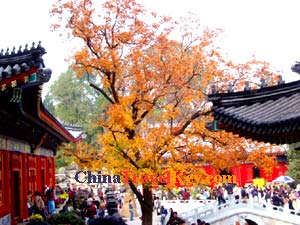 The
name of the park derives not from the fresh air or aroma in the area,
but in the shape of the hills themselves. 2 big stones lie on its peak
and from a distance, on a mist-shrouded day, it looks much like a three-legged
incense burner. The groves of apricots, peaches, pears and lilacs may
also be reason for the name Fragrant Hills. Visitors to the park can
reach the peak by trekking up the hill or by taking a cable car. The
name of the park derives not from the fresh air or aroma in the area,
but in the shape of the hills themselves. 2 big stones lie on its peak
and from a distance, on a mist-shrouded day, it looks much like a three-legged
incense burner. The groves of apricots, peaches, pears and lilacs may
also be reason for the name Fragrant Hills. Visitors to the park can
reach the peak by trekking up the hill or by taking a cable car.
Being richly
endowed by nature, the park has 280,000 various trees in it. Among them
there are more than 5800 ancient as well as rare trees, which takes
up 1/4 of Beijing area. With a 98% forest coverage, the park is examined
to an area with highest negative oxygen ion in recent years. In the
park, birds sing, streams flow, squirrels play with each other in green
gaps, and all the things enjoy a harmony with nature. In late autumn,
when hundreds of thousands of common smoke trees turn red, the boundless
scene is the most distinguished autumn scenery.
From the
peak of Fragrant Hill, the winding Yongding River like a white silk
belt fluttering among the western valleys, the Marco Polo Bridge on
the river, Shijing Mountain, the Summer Palace and Jade Spring Mountain
can all be seen from here, and on a clear day one can even make out
the skyline of Beijing.
History
In 1186 of the Jin Dynasty, the Xiangshan Temple was built here
and for a period served as the emperors traveling lodge. In 1745, Emperor
Qianlong had a number of large halls; pagodas, memorial archways and
leisure pavilions built and changed the name of the area to Jingyiyuan.
Unfortunately, almost every trace of this landscape architecture was
burned or destroyed by the Anglo-French forces and the eight-Power Allied
Forces in the 19th and early 20th centuries. After 1949, it was renamed
Fragrant Hills Park. More
information...
Visit routes
 Various temples and scenic spots are scattered around the hill. Tourists
usually take two routes to explore the whole park. The first choice
is to go along the path northward and then turn left, where you will
see Luminous Temple (Zhaomiao). Next to the Bright Temple, Studio of
Tranquil Heart, down the path to the east, there is a clear lake. The
other route goes to the southern part. Its main attractions include:
Tranquility Green Lake, Shuangqing Villa, Ruins of Fragrant Temple,
the Jade Flower Villa, the Ruins of Xiangshan (Fragrant Hills) and Incense
Burner Peak. More
information... Various temples and scenic spots are scattered around the hill. Tourists
usually take two routes to explore the whole park. The first choice
is to go along the path northward and then turn left, where you will
see Luminous Temple (Zhaomiao). Next to the Bright Temple, Studio of
Tranquil Heart, down the path to the east, there is a clear lake. The
other route goes to the southern part. Its main attractions include:
Tranquility Green Lake, Shuangqing Villa, Ruins of Fragrant Temple,
the Jade Flower Villa, the Ruins of Xiangshan (Fragrant Hills) and Incense
Burner Peak. More
information...
Scenic
Spots
Fragrant is rich in cultural relics and historic sites and a lot of
terraces, pavilions and pagodas are scattered there. among them ,there
are Temple of Azure Clouds demonstrating a architecture combining Qing
style an Ming style; The sole wooden gilding "500-arhat Hall"
in the country; Bright Temple which was built in 1780 as a residence
for the Sixth Bainqen Erdeni when he visited Beijing; Palace of Tranquil
Heart which is characterized by South-styled elegance; Shuangqing Villa
where Gaozehdong and the center of Chinese Communist Party 's office
located when they entered Beijing; Temple of Azure Clouds Giant Throne
Tower where Doc. Sunyetsin 's coffin was placed, Western Hills Snow
which is more of Yanjing Eight Scenes. More
details...
Beijing Tour Routes Includes Fragrant Hill:
BD-13. Fragrant Hill, Botanical Garden and Beijing Zoo
Chinatravelkey can add Fragrant Hill on the following tours based on extra 15 USD per person.
Photo of Fragrant Hill:
       
|

 Home: China Attractions : Beijing Attractions :
 Home
Home