Since the
systematic excavation of the Peking Man Site in 1927, more than 20 valuable
localities have been discovered and excavated.
1. The
Peking Man Cave or Locality 1:
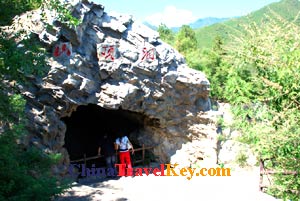 On
the western side of Zhoukoudian Village, there are two parallel hills.
The one on the east is lower and called Dragon-bone Hill. It is 220
metres long in north-south direction and 190 metres wide in east-west
direction. Its peak is 140.6 metres above sea level and is 66 metres
above the river bed of Baerhe. On the northern slop of the Dragon-bone
Hill, there is a huge cave. Judging by the deposits inside it, the cave
has a length of about 140 metres east-west, but its north-south span
is about 40 metres in width at the most. Its western end is the narrowest
and is only 2 metres wide. On the northern side of the cave, a fissure
is extending northwards and its width is about 7 metres. On
the western side of Zhoukoudian Village, there are two parallel hills.
The one on the east is lower and called Dragon-bone Hill. It is 220
metres long in north-south direction and 190 metres wide in east-west
direction. Its peak is 140.6 metres above sea level and is 66 metres
above the river bed of Baerhe. On the northern slop of the Dragon-bone
Hill, there is a huge cave. Judging by the deposits inside it, the cave
has a length of about 140 metres east-west, but its north-south span
is about 40 metres in width at the most. Its western end is the narrowest
and is only 2 metres wide. On the northern side of the cave, a fissure
is extending northwards and its width is about 7 metres.
Peking Man cave is a karst cave developed in limestone of Ordovician
age (about 450 million years ago). Since Zhoukouhe Stream and the karst
cave were connected with each other, a quantity of sand-gravel flew
inside the cave. The rough and deep ditches inside the cave were gradually
filled, thereby forming a flat surface. The eastern entrance gradually
expanded as weathering took place. After that, Peking Man entered the
cave through eastern hill to settle there. He was at first inhabited
at the eastern part of the cave near the entrance. The roof portion
was completely preserved but there was sufficient light inside the cave
so as to facilitate their activities without difficulty. Due to the
collapse of roof rocks of the eastern cave, the entrance became completely
blocked and Peking Man was obliged to turn to the western entrance of
the cave. The period the cave was almost completely filled with sediments
might be sometime around 230,000 years before present. When Peking Man
left the cave and moved elsewhere it was no longer suitable for hominids'
habitation.
Before
excavation, the cave was completely filled with deposits more than 50
metres in depth. The deposits were divided by scientists into 17 layers
from top to bottom. The absolute age of the 13th layer is about 730,000
years old, that is to say, layers 14 to 17 are formed before the Middle
Pleistocene. Layer 10, the lowest layer bearing Peking Man fossil, is
dated about 500,000 years ago, while Layer 3, the upmost layer bearing
Peking Man fossil, is dated from 230,000 to 250,000 years ago. Thus,
Peking Man had lived in the cave for about 260,000 years.
2. Locality
4 or New Cave:
The cave is situated 70 metres south of Locality 1. It measures 4 metres
high, 9.5 metres wide, and 116 metres above sea level. Its entrance
is formed by a narrow and long fissure and opens southwards. Its terminal
end enlarges to form a big hall. The entrance was blocked by mixed deposits.
It was opened after the excavation in 1973. A left upper first molar
of early Homo sapiens, an intermediate form between Homo erectus of
Locality 1 and late Homo sapiens of Upper Cave, was discovered in the
cave. Some paleoanthropologists call the human fossil New Cave Man.
This locality yielded also a small quantity of stone tools, ash layer,
burnt stone, charred bones, hackberry seeds, and more than 40 species
of mammalian fossils. Its absolute age is dated about 200 000 to 100,000
years before present. Its geological age is attributed to Late Pleistocene.
3. Locality
15:
Situated
70 metres south of Locality 1, about 10 metres west of Locality 4. The
original appearance of the locality was a cave or a fissure, but it
completely collapsed and left only piles of broken rocks. It was discovered
in 1932 and excavated from 1934 to 1937. The excavated area measures
13 metres east-west, 16 metres north-south. The deposits measure 10
metres in depth which can be divided into three layers. The upper layer
is mainly of light yellow earth with worm-like wedges of calcified substance
in central portions. The middle layer consists of a large mass of limestone,
ash with charred bone, and hackberry seeds. The lower layer contains
light reddish earth with pieces of limestone. Stone tools and mammalian
fossils were distributed in all of these layers. The excavated stone
tools count about 10 thousands pieces include cores, flakes, etc. It
is one of the representative middle Palaeolithic industries of China.
Discovered mammalian fauna is composed of 33 species, such as thick
jaw deer, Gray's sika, rhinos, sheep etc. Its age is equivalent to that
of New Cave, that is, the early stage of the Late Pleistocene.
Professor
Jia Lanpo thinks that the New Cave and Locality 15 might connect with
Locality 1 by some unknown tunnels and therefore they are worth of new
excavation.
4.
Upper Cave:
Situated at the upper part of Dragon-bone Hill, hence the cave was so
named. The northern part of the cave is close to the southern fissure
of Peking Man Cave. The original entrance of Upper Cave is open to the
north. The altitude of the cave is about 125 metres. The cave is about
13.5 metres long, 5.6 metres wide and composed of 4 parts: cave entrance,
upper chamber, lower chamber and lower recess. It was discovered in
1930 during investigation of the border of the Peking Man Cave deposit
and was excavated in 1933-34. The bottom layer of Upper Cave was directly
deposited above the first layer of Peking Man Cave deposit.
Three well preserved skulls and a skull cap of Upper Cave Man were unearthed
from the lower chamber. Some pelvic and femur bones were found nearby
the skulls. All human bones represented about 10 individuals. Anthropologists
have attributed Upper Cave Man to Late Homo sapiens. His absolute age
is dated about 27 thousand years before present. On the left side of
the skull of an elderly Homo sapiens, a perforated shell and perforated
fox's canine were recovered. Animal fossils of entire skeletons were
found and interpreted to be there after falling into natural traps.
The deposits of Upper Cave are composed of pine tree loam and limestone
breccia. The bottom earth is reddish and partly concretion. From 20
metres deep, about 860 cubic metres of deposits were removed at the
time of excavation. There were 25 artifacts, a polished antler, a bone
needle, 141 ornaments including 125 perforated animal teeth, three perforated
shells, a perforated ovoid pebble, one perforated supra-orbital of fish,
four bones perforated with transverse farrows, and 7 perforated stone
beads. In addition to fish and amphibian fossils, 47 species of mammalian
fossils were found. The geological age is of late stage of the Late
Pleistocene.
To summarize, human or animal fossils or cultural relics were found
at 26 localities in Zhoukoudian area. Among the localities yielded human
fossils, locality 1 yielded Homo erectus fossils, early Homo sapiens
fossils are from locality 4 or New Cave, and late Homo sapiens fossils
are found in Upper Cave. As to artefacts, early palaeolithic tools were
found at localities 1 and 13, middle palaeolithic tools are from localities
4 and 15, and late palaeolithic tools are found from the Upper Cave.
Thus, each stages of palaeolithic industry were unearthed at different
localities of the Site. Fossil discoveries representing various stages
were also abundant in the Site. There are Late Cenozoic fishes from
locality 14, and from the top deposit in locality 12. The mammalian
fauna of Zhoukoudian locality 1 is the typical Middle Pleistocene fauna
of North China and Upper Cave yielded the typical Late Pleistocene fauna
of North China.
To protect
and conserve the Peking Man Site at Zhoukoudian well, the State Council
announced in 1961 the designation of the Peking Man Site at Zhoukoudian
as one of the first State Key Cultural Heritage Units under Protection.
In 1983, Beijing Municipal Government designated the Protection Area
for Preservation of the Peking Man Site at Zhoukoudian.
The site
is not only an exceptional reminder of the human societies of the Asian
continent hundreds and thousands of years ago, but also illustrates
that the process of hominization can only be fully apprehended on a
world wide scale with the help of many such examples. Because the Peking
Man Site at Zhoukoudian bears unique testimony to a civilization which
has disappeared and bears witness to the human communities of the Asian
continent from the Middle Pleistocene to the Late Pleistocene (Palaeolithic
Age), it was formally inscribed on the "World Heritage List"
in December 1987 at the eleventh session of UNESCO World Heritage Committee.
The inscription of the Peking Man Site on the World Heritage List confirms
the exceptional and universal value of the cultural site which requires
protection for the benefit of all humanity. The site is therefore not
only of China, but also of the world as a whole.
Photo of Beijing Man Site
       
Chinatravelkey can add Beijing Man Site on the following Beijing Tour Routes
|

 Home: China Attractions : Beijing Attractions :
 Home
Home