It is said
that the earliest humanist sight of Fragrant Hills appeared at Xijin
Dynasty when a Toist, a pioneer of chemistry research in china history,
select this beautiful place with his vision to pursue his longevity.
In
1186 of the Jin Dynasty, the Xiangshan Temple was built here and for
a period served as the emperors traveling lodge. 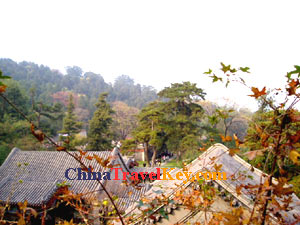 In 1745, Emperor Qianlong
had a number of large halls; pagodas, memorial archways and leisure
pavilions built and changed the name of the area to Jingyiyuan, which
means Garden of Tranquility and Pleasure. This complex served the famous
Qing ruler as one of his summer palaces and became one of the three
favorite hills of Qianlong, beside Jade Spring Mountain (Yuquanshan)
and Longevity Hill (Wanshoushan) in the Summer Palace. Qianlong s elaboration
of the park consisted of 28 separate vistas, each with a poetic name:
Jade China Cliff, Toad Peak, Jade Milk Spring, Bell Separated from the
Clouds, etc. In 1745, Emperor Qianlong
had a number of large halls; pagodas, memorial archways and leisure
pavilions built and changed the name of the area to Jingyiyuan, which
means Garden of Tranquility and Pleasure. This complex served the famous
Qing ruler as one of his summer palaces and became one of the three
favorite hills of Qianlong, beside Jade Spring Mountain (Yuquanshan)
and Longevity Hill (Wanshoushan) in the Summer Palace. Qianlong s elaboration
of the park consisted of 28 separate vistas, each with a poetic name:
Jade China Cliff, Toad Peak, Jade Milk Spring, Bell Separated from the
Clouds, etc.
Unfortunately,
almost every trace of this carefully orchestrated symphony of landscape
architecture, including the blueprints, was burned or destroyed by the
Anglo-French forces and the eight-Power Allied Forces in the 19th and
early 20th centuries. During that period , the park was seriously destroyed
by fire and many of the temples and halls ruined. Today, only some of
the buildings have been restored.
When the
Central Committee of the Communist Party moved to Beijing from Hubei,
Mao made Double Purity Villa his residence here. Inside the Villa are
various displays and cultural relics. However, it's the views of the
countryside, which are the most attractive thing about the Park. After
1949, it was renamed Fragrant Hills Park.
Beijing Tour Routes Includes Fragrant Hill:
BD-13. Fragrant Hill, Botanical Garden and Beijing Zoo
Chinatravelkey can add Fragrant Hill on the following tours based on extra 15 USD per person.
Photo of Fragrant Hill:
       
|

 Home: China Attractions : Beijing Attractions :
 Home
Home