-
Luminous Temple (Zhaomiao): This is a Tibetan-style complex built
in 1780 as the
residence for the Sixth Panchen Lama when he visited Emperor Qianlong.
In its center, a Red Terrace rises 10 meters above the ground. A majestic
glaze-tiled gateway in front of the complex is famous for its clouds
and dragon design. On the slope to the west is a seven-story glazed
pagoda, the eaves of which are hung with tiny bells, which tinkle
with even the slightest breeze.
-
The Tree-Covered Imperial Audience Tablet: Located to the southwest
of the Chaoyang Caves, this group of steep cliffs with numerous trees
resembles a giant "hu" -the rectangular tablet officials
held before themselves in the presence of the emperor.
- Ghost Fear Peak (Guijianchou) : The main peak of Fragrant
Hill Park, Ghost Fear Peak had an elevation of 557 meters. Clouds
and mist often engulf its precipitously angled cliffs, which give
the two large stone excrescences of the peak a resemblance to incense
burners.
-
Snow-covered Xishan on a Sunny Day
The snow in winter on the Fragrant Hills offers a fascinating view.
It was once listed as one of the Eight Famous Spots in the capital
of the Yan Dynasty. There is an interesting story about the spot.
Although the tablet was erected more than two centuries ago, the "Snow-covered
Xishan on a sunny day" inscription made by Emperor Qianlong of
the Qing Dynasty is still glittering. It is said that in 1750, the
15th year during Emperor Qianlong's reigning period, there was no
snow in the whole winter and no rainfall during the following spring.
The emperor and his ministers were very anxious. One day, Emperor
Qianlong led a team to hunt on Xiangshan Mountain to scatter the concerns.
After getting out of the Xizhimen, when they were passing the Qinglong
Bridge, they found a large piece of snow-white area in the cove of
Xiangshan that looked like heavy snow. The emperor was pleasantly
surprised and when they hurried to the area, they fund the whiteness
was over a hundred thousand almond trees in blossom and the mountain
was giving enchanting fragrance. Deeply touched by the scene, Emperor
Qianlong gladly wrote down "Snow-covered Xishan on a sunny day".
Some other record indicated that the tablet inscription was made because
Emperor was moved by the magnificent view of Xishan after a heavy
snow. Whether "Snow-covered Xishan on a sunny day" originated
from the splendid view of Xiangshan after a heavy snow or the over
100,000 almond trees in blossom and their enchanting fragrance could
not be observed and studied. Anyway, it is a beautiful legend that
makes the hills enchanting.
- Incense Burner Peak
The
Incense Burner Peak is the summit of the Fragrant Hills. To its west
is a precipice nicknamed the Devil Frowning Peak, which is very difficult
to climb. On top of the hill is a huge piece of rock, which looks
like an incense burner at a distance, so it is also named the Incense
Burner Peak. It is 557 metres above sea level, the highest peak among
the nearby hills. Up there, visitors can have a magnificent view of
the surrounding area.
There are 3 pavilions built there, each with a poetic name. The Chongyang
(Double Ninth) Pavilion is a perfect choice for mountain climbing
in autumn. Perching on the peak and overlooking below to appreciate
what Du Fu has written in his poem about Mountain Tai "Let me
climb the top most of TAI and see all the others bow before my knee".
Tayun(Floating Clouds) Pavilion, as the name indicates, is peculiar
for the beautiful floating clouds which appeared after rain falls.
Passing through the pavilion slowly with slight fog and comfortable
moisture, the clouds make you wonder yourself standing in a fairyland
of heaven. To the southwest of Incense Burner Peak lies the famous
Ziyan(purple smoke) Pavilion, which got its name from the poem of
Li Bai "The sunlit Censer peak exhales a wreath of cloud;Like
an upended stream the cataract sounds loud".
- Terrace
One hundred meters southeast to the Xishanxueqing (west mountain covered
with white snow) spot and 450 meters south to the mid-station of cableway
there is a 2050-square-meters flat ground for tourists to have drinks
or take a short break. The site is the juncture of several routes
and thus a must-to-pass place for people. Sitting there you may have
a full view to the beautiful scenary around. To the
south is the flaming cloud dyed by maple leaves stretching to the
sky. To the west is the marvelous Incense Burner Peak. You may also
share the happiness of those who sitting in the chairlift in the north,
or the excitement of those who claiming triumph on the mountain peak
in the east. Besides, the ground offers body fitness facilities and
planted with heavy green pines trees, where you can enjoy a cool and
pleasant staying.
- Jade Flower Villa
Yuhuaxiu (jade flower villa) was one of the 28 sights in the park.
It was the appendix building of Yuhua Temple, which was built during
the regime of Qianlong in Qing period. The spot was burned down by
the Eight-Power Allied Forces in early 20th centuries. However, the
park administration decided to rebuild the site and lauched a restoration
project in 1999. The newly-built complex will consist of an entrance
archway, Tianwang (the God of Heaven) Hall, Yuhuaxiu, Yaoyue (Inviting
Moon) House, Yiwang (Looking into Distance) Pavilion, Yifangxuan(Fragrance
Overfilling) Walking Corridor, and etc. It is a truely "Garden
within Garden" with enchanting scenary and typical imperial-style
architectures. Part of the halls have been successfully restored to
their original looks yet some were used to exhibit pieces used by
royals. With ideal geographic location and peaceful quietness, the
site is a good spot for viewing the charming mountain view and red
leaves in late autumn.
-
Cuiwei Pavilion
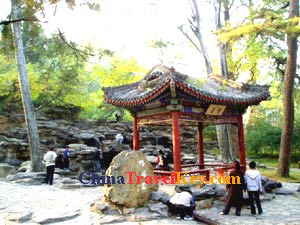 Located in the south part of Jingcui lake, Cuiwei(Jade Green) Pavilion
is one of the 28 sites of the park. It was built in 1745. Embraced
by ancient trees, green woods, valleys and mountain rocks, the spot
trickily hides itself among a dense green. Thanks to the heavy woods,
the spot is fairly cool in summer.
Located in the south part of Jingcui lake, Cuiwei(Jade Green) Pavilion
is one of the 28 sites of the park. It was built in 1745. Embraced
by ancient trees, green woods, valleys and mountain rocks, the spot
trickily hides itself among a dense green. Thanks to the heavy woods,
the spot is fairly cool in summer.
- Shuangqing Villa - Double Fountains Villa
In
the southeast corner of the park is a small pool fed by two springs
named Shuangqing or "Two Streams." The water from these
springs is not only clear but also rare in north China. It contains
no alkali in it. The exquisite compound is complete with hills, springs,
trees, rockeries and bamboo. Two fountains in the western part gave
its name Shuangqing (Double Fountains). The name plaque is in the
handwriting of Emperor Qian Long.
In 1949,
the central committee of CPC and China's top leaders chose the villa
as their temporary residence before moving to Zhongnanhai. Here the
late Chairman Mao and other Chinese leaders did a lot of work for
the liberation of whole China and the founding of the People's Republic
of China. A huge amount of written works were also produced here by
Chairman Mao, such as the famous poet PLA has
taken the power over Nanjing. In 1994, Shuangqing Vila was named "A
Youth and Children Education Base of Beijing". The villa maintained
the original state and furniture of the days when Mao Zedong worked
and lived here; there is also the Hexangular Red Pavilion, a place
where Mao Zedong had intimate talks with his endeared sons. Here you
can also have a look of the "Exhibition on Mao Zedong's Activities
in Shuangqing Villa" that records part of the PRC founder's life.
The "Exhibition on Mao Zedong's Activities in Shuangqing Vila"
is made up of three parts, "From Xibaipo to Xiangshan in Beijing",
"Mao Zedong in the Shuangqing Vila", "Life of the National
Leaders on Xiangshan". The Exhibition collectively reflects the
military talents of Mao Zedong and some other leading proletariat
revolutionists to devise strategies and determine the results of battles
thousand miles away. It is also an exhibition of the trial and hard
working life of the PRC founders.
The park
specially opens a store selling books and souvenirs about Mao Zedong.
In the villa, the park also plays videos about "Mao Zedong in
Shuangqing Villa" and other related programs about historical
materials.
-
Xiangshan Temple
In 1186 of the Jin Dynasty, the Xiangshan Temple was built here
and for a period served as the emperors traveling lodge. In 1745,
Emperor Qianlong had a number of large halls; pagodas, memorial archways
and leisure pavilions built and changed the name of the area to the
Garden of Peacefulness (Jingyiyuan). This complex served the famous
Qing ruler as one of his summer palaces and became one of the three
favorite hills of Qianlong, beside Jade Spring Mountain (Yuquanshan)
and Longevity Hill (Wanshoushan) in the Summer Palace. In late 1800s,
it was burned down by British and French invaders.
According
to "History of Jin Dynasty", "in March 1186, the construction
work on Xiangshan Temple was completed. The emperor visited the temple
and granted it the name of "Forever Peace Temple" and offered
it 133 hectares of land, 70 chestnut trees, and 20,000 strings of
cash." Later, Renzong Emperor of Yuan Dynasty rebuilt the "Forever
Peace Temple" on Xiangshan and renamed it "Amrita Temple".
Then in the following Ming Dynasty, Fan Hong, a eunuch in charge of
rituals "donated some money, bought some materials, and employed
some labors to rebuild the temple. The halls, pavilions, corridors,
and statues looked brand-new, solemn, and magnificent. When the emperor
heard the news and granted the temple a stele with the name of 'Forever
Peace Buddhist Temple'." Later, another eunuch, Wang Gongchen,
donated some money to repair the temple. During following years, the
temple repeatedly got scriptures and additional paintings and statues
from the government. Then a eunuch in charge of horses, Zheng Gongtong,
was concerned that someday the temple's buildings, lands, and woods
may be transgressed and applied to the emperor for protection. The
emperor approved the application and the temple's abbot Xiejin was
much appreciated for the emperor's great favor. A magnificent ceremony
was held to celebrate the issue.
 In 1677,
governors of the Qing Dynasty started to a royal garden in the northwestern
suburb of Beijing and the Xiangshan Xannadu was completed, whose scope
was around the Xiangshan Temple. Then in 1744, a Xiangshan Engineering
Office was established. In the following year, 1745, construction
work started in Xiangshan. Two years later, Xiangshan Temple was listed
one of the 28 major scenes of Jingyi Garden. Emperor Qianlong granted
the temple the name of "Xiangshan Forever Peace Buddhist Temple."
In 1677,
governors of the Qing Dynasty started to a royal garden in the northwestern
suburb of Beijing and the Xiangshan Xannadu was completed, whose scope
was around the Xiangshan Temple. Then in 1744, a Xiangshan Engineering
Office was established. In the following year, 1745, construction
work started in Xiangshan. Two years later, Xiangshan Temple was listed
one of the 28 major scenes of Jingyi Garden. Emperor Qianlong granted
the temple the name of "Xiangshan Forever Peace Buddhist Temple."
In 1746, in a poem by Emperor Hongli, it was written that "the
temple was first built during Shizong Period of the Jin Dynasty according
to the mountain's landforms. The temple's major building was made
up of 5 floors and look resplendent and magnificent. Looking from
blow, visitors can clearly count the floors. The temple once had the
name of Forever Peace and Amrita." During the Qianlong Period,
the Xiangshan Temple got some repair and it was the top one among
the temples in Xishan area.
Xiangshan
Temple is to the west of the Yingluo Stone and to its north, there
is a towering decorated archway made up of 4 pillars and three rooms.
Passing the archway, on both sides of the way to Zhilehao are shops
selling various commodities. At the east end of Zhilehao is another
towering decorated archway made
up of 4 pillars and 3 room. This archway carries a stele written by
Qianlong Emperor of Qing Dynasty, "Fragrant Cloud Circulating
the Seat". Further up the mountain is the "Buddhist Leading-in
Hall" of Xiangshan Temple. The major hall is made up of 3 rooms,
and on both sides of the hall are two splay and carved walls. Before
the hall are two masts. On the front wall of the hall, there hangs
a stele of "Xiangshan Forever Peace Temple". The golden
inscription on the blue background was a calligraphy treasure left
behind by Emperor Qianlong.
Further
up is a three-room "Heaven Emperor Hall" of "Forever
Peace Temple". Above the door hang five steles with poem inscriptions
made by Emperor Qianlong. The characters are blue, while the background
is painted with pink paint. On both sides of the platform behind the
hall, there is a bell building and a drum building. Both these buildings
are of two floors. On the north side of the road is a square stele
pavilion. In it is a royal stele made in 1746 to memorize a famous
Buddhist.
Further
up again, on the south and north side of the platform, each side stands
an octagonal stele with double eaves. Follow the road and climb upward,
you will see another towering decorated archway. Behind the archway,
there are two 3-room secondary halls to the "Soul Presentation
Hall". In the 3-room south secondary hall, there is an altar
facing northward in the middle room. Among the 3 rooms of the north
secondary hall, there is an altar facing southward in the middle room.
Climb the steps, you will see a 7-room "Soul Presentation Hall".
In the three rooms in the middle, there is a major altar. Under the
eave of the major hall, there is a "Soul Presentation" stele
facing eastward. The copper characters were carved on blue backgrounds
and the inscription was a calligraphy work of Emperor Qianlong. Outside
the hall, there are five bronze sacrifices on stone bases and a large
iron censer on a stone base. In front of these sacrifices, there is
a stone screen with diamond sutra, left-heart sutra,, and right Kwan-yin
scriptures. Behind the screen respectfully engraved a writing brush,
candle-igniter, ancient Buddha statues, and statues of Kwan-yin and
other Buddha figures as well as compliments made by Emperor Qianlong.
On both
sides of the "Soul Presentation Hall", there is a mantle
gate. On the high platform behind the hall, there is a 3-room "wide
vision" open hall. On the eave of the middle room, there hangs
a stele of "Wide Vision" and the blue characters are carved
on green background. The stele is also a calligraphy work of Emperor
Qianlong. The "wide vision" is connected with corridors
on the south and north sides. These corridors wind upward and connect
the building of "rosy cloud expressing leisure mind".
The "rosy
cloud expressing leisure mind" building is made up 2 floors,
each floor with three rooms. On the front eave of the lower floor
hangs a "rosy cloud expressing leisure mind" stele that
faces eastward. The character is golden while the background is green.
The stele is a calligraphy work made by Emperor Qianlong. On the second
floor, the outer eave also hangs a stele "Golden Eagle Peak among
Clouds" facing eastward. This stele is also of golden characters
on green background and a calligraphy work of Emperor Qianlong.
Under
the "rosy cloud expressing leisure mind" building, close
to the wall there is a 3-room "clean water and bright moon"
hall. On the outer eave of the hall hangs a "clean water and
bright moon" stele with blue characters on green background.
It is a calligraphy work of Emperor Qianlong.
In front
of the "clean water and bright moon" hall, there is a hexangular-shaped
3-room building, "Auspicial Fragrant Woods". On the first
floor, there is a "Auspicial Fragrant Woods" stele facing
eastward. The stele is of blue characters on pink oil background and
an inscription of Emperor Qianlong. On the second floor, on the outer
eave of the pavilion is a stele of "forever running law wheel"
with blue characters on pink oil background. It is also a calligraphy
work of Emperor Qianlong. On the internal partition of the 3rd floor,
there hangs a stele of "master of benevolence and clever perception"
written by Emperor Qianlong. On the outer eave of the pavilion, there
is another stele, "the bright Buddhist world" facing eastward,
also of golden characters on pink oil background and written by Emperor
Qianlong.

 Home: China Attractions : Beijing Attractions :


 Home
Home